Dynamic Resume Adjustments: Career Change Guide
Switching careers can be challenging, but crafting a resume tailored to highlight transferable skills and align with your new industry can make all the difference. Here’s what you need to know to create a resume that stands out:
- Use a combination resume format: This blends a skills-focused summary with a clear work history, making it ideal for career changers.
- Focus on transferable skills: Identify and emphasize skills from your past roles that align with your new career goals.
- Tailor your resume for each job: Use job-specific keywords to ensure compatibility with Applicant Tracking Systems (ATS).
- Craft a strong summary or objective: Clearly connect your past experience to your new career goals.
- Highlight relevant achievements: Use measurable results and examples to show how your background brings value.
- Include certifications and training: Showcase recent or ongoing education that supports your career transition.
AI-powered tools like ScoutApply.com can simplify this process by optimizing your resume for ATS, suggesting keywords, and managing multiple versions tailored to different roles. With these strategies, you can present yourself as a strong candidate, even in a new field.
How to Write a Career Change CV | Job Winning Resume Examples
Selecting the Right Resume Format for Career Changes
When switching careers, choosing the right resume format can make all the difference. The goal is to emphasize transferable skills while maintaining a professional narrative that employers find credible. This decision becomes even more critical for career changers, as you need to showcase your capabilities in a way that aligns with the expectations of your target industry.
Resume Format Comparison
There are three main resume formats to consider, each with its strengths and weaknesses. Understanding these can help you align your resume strategy with what employers are looking for.
The chronological resume is the most commonly used format across industries. It emphasizes your work history in a timeline, showcasing career growth through measurable achievements. This format is ideal if your previous roles align closely with your new career goals. However, it may not be the best choice if your past experience doesn’t directly relate to your target field.
The functional resume shifts the focus to your skills rather than your job history. While this might seem like a good option for career changers, it often raises red flags for employers. Recruiters tend to prefer seeing a clear work history alongside your skills, as it provides context and demonstrates progression.
The combination resume blends elements of both formats. It begins with a summary of your relevant skills and qualifications, followed by a detailed work history. This hybrid approach allows you to highlight your transferable skills while maintaining the transparency employers value.
| Format | Primary Focus | Best For Career Changers | ATS Compatibility | Employer Reception |
|---|---|---|---|---|
| Chronological | Career timeline and progression | Best if past roles align with goals | Generally strong | Preferred by most recruiters |
| Functional | Skills and qualifications | Not ideal - may raise concerns | Often weak due to non-standard structure | Generally avoided |
| Combination | Skills and work experience | Highly recommended | Strong if keywords are used effectively | Widely accepted and flexible |
Why Combination Format Works for Career Changers
The combination resume is often the best choice for career changers because it strikes the right balance between showcasing skills and providing a clear work history. It allows you to emphasize the qualifications most relevant to your new career while maintaining the transparency that recruiters value.
Unlike the functional resume, which can come across as vague, the combination format provides a structured narrative. For instance, if a retail manager is transitioning to human resources, they might highlight skills like Talent Development and Employee Relations with achievements such as training over 50 new hires and improving team performance by 25%. This is then supported by a concise job history that reinforces their expertise.
Additionally, this format works well with applicant tracking systems (ATS) when structured with relevant keywords. This means your resume is more likely to pass automated screenings and land in front of a recruiter. The flexibility of the combination resume also allows you to tailor it to the specific skills and achievements most relevant to the job, ensuring a polished and professional presentation that appeals to both technology and human reviewers. It’s a win-win approach for career changers looking to make a strong impression.
Writing a Resume Summary or Objective for Career Change
Your resume summary or objective is often the first thing employers read, so for career changers, it’s crucial to make it count. This short section should connect your past experience to your new career goals while showcasing your enthusiasm for the shift.
The choice between a resume summary and a resume objective depends on your experience level. If you have a solid work history with transferable skills, a summary is the way to go - it highlights the value you bring to the table. On the other hand, if you have limited experience or are making a significant career pivot, an objective works better, focusing on your goals and excitement for the new field. Think of this as your chance to craft a narrative that ties your past to your future.
Be specific. A good formula to follow is: state your relevant experience and skills, connect them to the role you’re targeting, and explain how you’ll contribute. Keep it short and impactful.
Avoid vague statements and replace them with concrete examples of how your background aligns with the role. For example, if you’re transitioning from teaching to corporate training, emphasize skills like curriculum development and public speaking instead of simply listing your previous job title.
Steer clear of common pitfalls. Don’t apologize for changing careers or use uncertain language like “seeking to transition into.” Instead, position yourself as someone who brings a fresh perspective and valuable skills from past experiences. Focus only on the abilities that align with the role you’re pursuing.
By applying these principles, you can craft a clear, compelling narrative that positions you as an asset in your new field.
Career Change Summary Examples
Here are some examples of how to effectively bridge your past experience with a new role by emphasizing transferable skills and accomplishments:
Marketing Manager to UX Designer:
"Marketing professional with 8 years of experience in consumer behavior analysis and campaign optimization, bringing expertise in user psychology and data-driven decision-making to UX design. Completed the Google UX Design Certificate and developed mobile app prototypes that combine marketing insights with user-centered design principles. Excited to apply analytical skills and customer empathy to create seamless digital experiences that drive engagement and business results."
Retail Manager to Human Resources Specialist:
"Operations-focused retail manager with 6 years of experience leading teams of 25+ employees, specializing in staff training, conflict resolution, and performance management. Achieved a 40% reduction in employee turnover by revamping training programs and introduced scheduling systems that boosted team satisfaction scores by 35%. Eager to bring people management expertise and operational efficiency to a human resources role."
Software Engineer to Product Manager:
"Full-stack developer with 5 years of experience creating customer-facing applications, blending technical expertise with stakeholder communication and project management. Directed cross-functional teams on more than a dozen product launches, turning business needs into technical solutions while managing timelines and resources. Now transitioning to product management to connect technical execution with strategic goals and user-centered solutions."
Each example follows a proven formula: start with relevant experience, include measurable achievements, and clearly explain how your skills will add value in the new role. Notice how the career change is framed as an advantage, showcasing unique insights and fresh perspectives.
Highlighting Transferable Skills for Your New Career
A successful career change starts with identifying transferable skills that connect your previous experience to your new role. These skills act as the bridge, helping hiring managers see how your background aligns with their needs. Highlighting them effectively sets the tone for tailoring the rest of your resume.
Take retail management, for instance. It equips you with abilities like coordinating teams, meeting deadlines, and communicating with stakeholders - skills that translate seamlessly to project management.
Finding Your Key Transferable Skills
Start by conducting a skills audit. Break down each role you've held into tasks, achievements, and responsibilities. Then, group them into two categories: hard skills (technical abilities) and soft skills (interpersonal strengths).
-
Hard skills often transfer more directly than you might think. For example:
- Curriculum development aligns with instructional design.
- Proficiency in Excel supports business analysis.
- Familiarity with electronic health records shows you're quick to adapt to new software.
-
Soft skills are often your most valuable assets when switching careers. Abilities like communication, problem-solving, leadership, and adaptability are universally sought after. For instance:
- Managing teams or training new employees showcases leadership potential.
- Resolving conflicts demonstrates problem-solving and interpersonal skills.
- Customer service experience highlights empathy and effective communication, which can easily transfer to roles in sales, account management, or user experience design.
Don’t overlook additional skills gained through volunteer work, side projects, or hobbies. Organizing a community event, managing social media for a nonprofit, or teaching yourself coding can reveal strengths that might not appear in your formal work history. Be sure to back up these skills with measurable examples, like: “Coordinated a team of 12 to raise $25,000 in six months.”
Matching Skills to Job Requirements
Once you've pinpointed your core skills, the next step is to align them with the language used in your target industry. Review 10–15 job postings for your desired role to identify recurring requirements and industry-specific terms. Pay close attention to terminology - what one field calls "stakeholder management", another might label "client relations" or "user advocacy."
ATS optimization (Applicant Tracking System) is key here. These systems scan resumes for specific keywords that match the job description. For example, if a posting mentions "cross-functional collaboration", use that exact phrase instead of a variation like "teamwork." This isn’t about cramming in keywords - it’s about speaking the industry’s language.
Here's a quick way to think about transferable skills:
| Your Background | Transferable Skill | Target Industry Language |
|---|---|---|
| Retail Manager | Staff scheduling and resource allocation | Project management and resource planning |
| Teacher | Lesson planning and curriculum development | Instructional design and content strategy |
| Sales Representative | Client relationship building | Account management and stakeholder engagement |
| Event Coordinator | Vendor management and timeline coordination | Supply chain management and project delivery |
Whenever possible, quantify your achievements to make them more impactful. For example:
- Instead of saying, “Managed inventory,” try: “Optimized inventory for 500+ SKUs, reducing waste by 15% and improving stock turnover by 22%.”
Tools like ScoutApply.com can help by analyzing job descriptions and suggesting relevant keywords to fine-tune your resume.
When presenting transferable skills, provide context by showing how they’ve been applied in relevant ways. For example, if you’re transitioning from hospitality to human resources, highlight how handling guest complaints demonstrates conflict resolution and customer service skills applicable to employee relations.
Sometimes, your skills may need reframing rather than a direct translation. A journalist’s knack for meeting tight deadlines under pressure is valuable in marketing, but it’s better to frame it as expertise in campaign delivery and time management rather than focusing on editorial processes. Always emphasize outcomes and the business value of your contributions, keeping your resume dynamic and ready for any career shift.
sbb-itb-e409340
Adjusting Work Experience and Education for Career Change
Once you've identified your transferable skills, the next step is to reshape your work experience and education to emphasize how they align with your new career path. The aim is to present your background as a strength, demonstrating to hiring managers how your diverse experiences can bring fresh perspectives and value to their team.
Presenting Relevant Experience
Highlight the most relevant roles first. Instead of sticking to a strict chronological order, consider listing the positions most connected to your target role at the top. For example, if you're shifting back to marketing after years in retail management, lead with your earlier marketing experience, clearly noting the dates.
Tailor job descriptions to match your target industry. Focus on the skills and accomplishments that align with your new field. A restaurant manager transitioning to operations management might emphasize expertise in supply chain coordination, vendor negotiations, and streamlining processes, rather than detailing food service responsibilities.
Use metrics that resonate with your new industry. Each industry values different performance indicators. Retail might prioritize sales growth, while tech could focus on user engagement, and manufacturing might emphasize productivity improvements. Research these metrics and frame your achievements in terms that your target industry understands and values.
Reframe career gaps as growth periods. Instead of leaving gaps unexplained, use them to showcase professional development. For instance, label a gap as "Professional Development & Skill Building (2022-2023)" and list certifications, courses, or projects you completed during that time.
Don’t overlook volunteer work or side projects. These can often be the most relevant experiences for career changers. For example, if you're moving from finance to nonprofit work, your experience as a volunteer treasurer might be more applicable than your previous corporate role. Treat these experiences as seriously as paid positions, detailing your accomplishments and skills gained.
Once your experience is tailored, focus on certifications and training to strengthen your qualifications further.
Enhancing Your Profile with Relevant Credentials
Showcase recent and ongoing certifications prominently. Place new certifications near the top of your resume or within your education section. For instance, a Google Analytics certification earned recently could carry more weight for a marketing role than a degree completed years ago. Include details like completion dates and issuing organizations: "Project Management Professional (PMP), Project Management Institute, November 2024" signals both relevance and recency.
Include in-progress coursework. If you're actively enrolled in a relevant program, list it with the expected completion date. For example, "Data Science Bootcamp, General Assembly, Expected completion: March 2025" indicates your commitment to building new skills.
Highlight specific coursework. When transitioning careers, the courses you've taken can often matter more than the degree itself. For instance, a psychology graduate moving into UX design should emphasize courses in research methods, statistics, and human behavior rather than just listing their degree.
Quantify professional development hours. Many fields value continuing education. If you've completed relevant training, include measurable details: "40 hours of digital marketing training through HubSpot Academy" shows a concrete investment in your growth.
Include workshops and short-term training. Even brief programs can demonstrate knowledge in a new industry. For example, "Agile Project Management Workshop, Scrum Alliance (16 hours)" could be a key selling point for a project coordinator role.
Create a "Professional Development" section if needed. If you’ve accumulated multiple certifications, courses, or training programs, consider grouping them in a dedicated section. This approach highlights your proactive efforts to build skills for your new career.
Using AI-Powered Tools for Resume Adjustments
Switching careers can be a daunting process, especially when it comes to crafting a resume that meets the expectations of a new industry. Traditional methods often fall short when it comes to optimizing resumes for Applicant Tracking Systems (ATS). That’s where AI-powered tools come in, simplifying the process and ensuring your resume aligns with ATS criteria.
These tools analyze job descriptions to pinpoint key requirements and guide you in tailoring your resume to match what employers are looking for. For career changers, this is especially helpful. They can highlight transferable skills and suggest ways to present your background that resonate with hiring managers in your target industry.
Many of these platforms offer features like guided editing, keyword recommendations specific to your field, and improved ATS compatibility. This makes the process of revising your resume more efficient and focused on delivering results.
ScoutApply.com Features for Career Changers
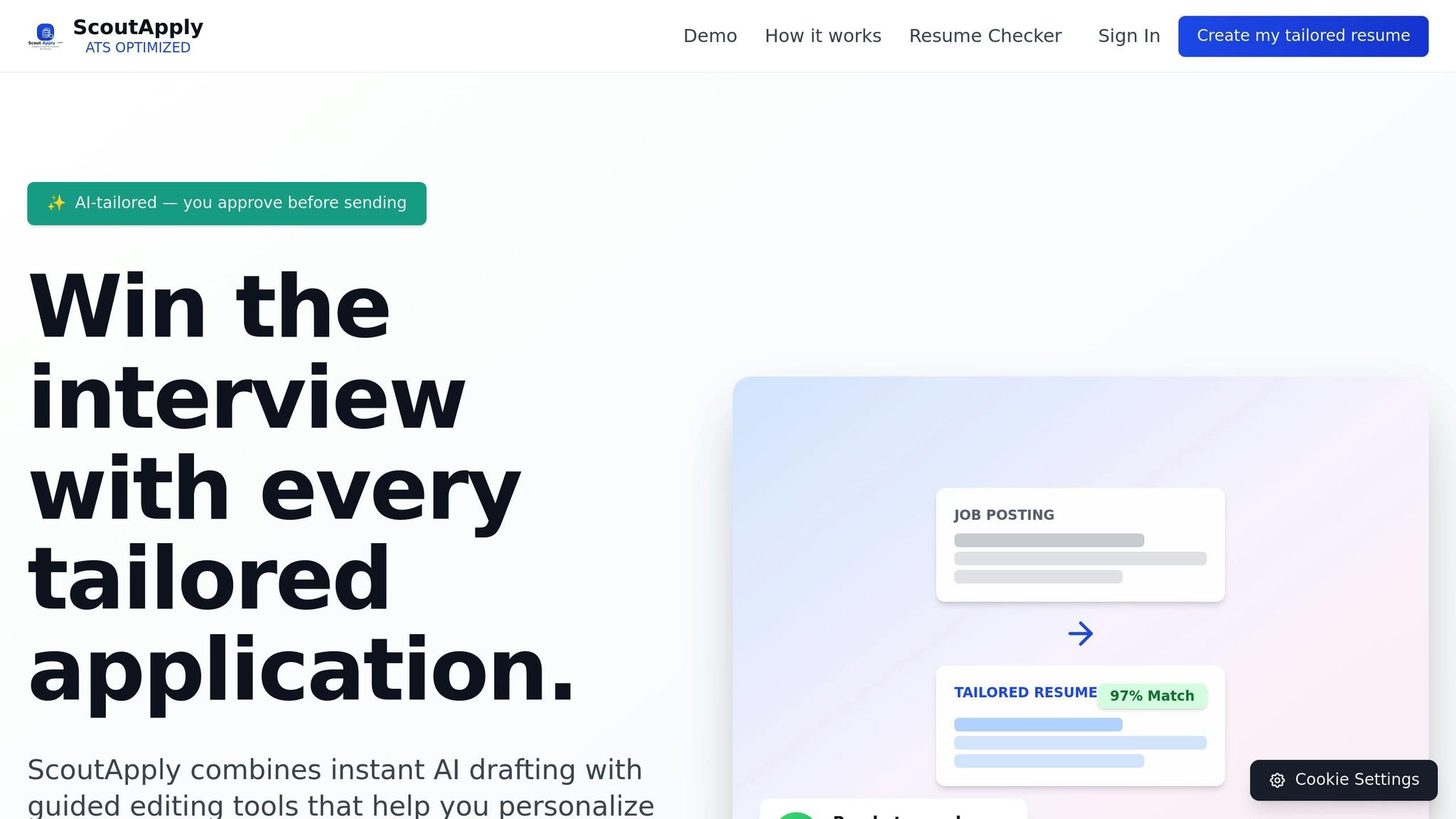
ScoutApply.com is a platform that integrates these AI-driven features seamlessly, making it a great resource for anyone navigating a career change. It provides tools for tailoring resumes and cover letters with ATS and recruiter review in mind, offering guided editing and real-time keyword optimization.
The platform includes professional templates designed to maintain ATS-friendly formatting while still appealing to human reviewers. These templates cater to a range of industries and experience levels, so you can select one that best showcases your unique skills and background.
ScoutApply.com also features an application tracking dashboard, which allows you to manage multiple job applications efficiently. You can maintain various versions of your resume tailored to different roles or industries. Additionally, the AI job discovery tool searches for roles that align with your profile and career goals, helping you uncover opportunities you might have missed otherwise.
Here’s an overview of ScoutApply.com’s subscription plans, tailored for professionals transitioning into new industries:
| Plan | Monthly Price | Resumes | Applications | Cover Letters | Key Features |
|---|---|---|---|---|---|
| Trial | $0.00 | 1 | 1 | 1 | Basic templates, AI job discovery, interview preparation |
| Plus | $7.99 | 5 | 5 | 5 | Premium templates, email support, priority support |
| Pro | $12.99 | 20 | 20 | 10 | Advanced analytics, priority support, enhanced AI features |
For career changers actively applying to jobs, the Plus plan at $7.99 per month is a practical choice. It offers flexibility to customize resumes for different roles, access to premium templates, and dedicated support. For those pursuing multiple career paths or requiring detailed customization, the Pro plan at $12.99 per month is a better fit. It includes advanced analytics to evaluate how well your resume aligns with specific job postings, helping you fine-tune it to better meet employer expectations.
ScoutApply.com also offers interview preparation tools, which can help you confidently communicate your career change journey. These tools ensure your story is consistent across your resume, cover letter, and interview responses, giving you a polished and professional edge.
Key Steps for Career Change Resume Success
Making a career change can feel daunting, but a well-crafted resume can be your ticket to success. The key is to strategically highlight transferable skills, choose the right format, and ensure your resume stands out to both hiring managers and applicant tracking systems (ATS).
Start by diving into job descriptions for roles in your target field. This will help you pinpoint the skills, qualifications, and responsibilities employers prioritize. Once you know what they’re looking for, you can identify which of your existing strengths align with those needs and figure out the best way to showcase them.
A combination resume works well for career changers. This format puts your skills front and center with a summary section, followed by relevant work experience. It shifts the focus from job titles to the competencies that matter most for your new role.
Write a concise resume objective that clearly explains your career shift and the unique value you bring. For example, mention your goals and how your background equips you to succeed in the new field.
When listing your work experience, reframe your accomplishments to emphasize transferable skills. Highlight measurable results that demonstrate abilities like leadership, problem-solving, or project management - qualities that resonate across industries.
If you’ve recently completed any education, certifications, or training related to your new career path, be sure to include those. They show your commitment to developing the expertise needed for this transition. Once your resume is updated, take advantage of tools to refine and personalize it further.
Tailor each application by incorporating job-specific keywords and aligning your skills and experience with the role. Platforms like ScoutApply.com offer AI-powered tools that can optimize keywords, guide edits, and manage different resume versions to ensure ATS compatibility and a polished presentation.
Finally, keep your messaging consistent across your resume, cover letter, and interview responses. This unified narrative will help you confidently communicate your career change story and demonstrate why you’re the right fit for the job.
FAQs
How can I determine which transferable skills are most relevant for a career change?
To pinpoint the most relevant transferable skills for your career shift, start by examining job postings in your desired field. Look for recurring qualifications and skills that employers prioritize. Then, take a close look at your past roles and identify instances where you’ve showcased similar abilities. Skills like communication, problem-solving, leadership, and project management are often highly valued across different industries.
Another helpful step is to get feedback from trusted colleagues, mentors, or career advisors. They can provide valuable perspectives on your strengths and how they align with your new career path. Finally, tailor your resume to emphasize these transferable skills, making it easier for potential employers to see your fit for the role.
How can I customize my resume for different jobs while ensuring it passes ATS screening?
To make your resume stand out and ensure it works well with Applicant Tracking Systems (ATS), start by matching your skills and experience to the job description. Incorporate keywords directly from the job posting to show you're a strong fit. Emphasize transferable skills that highlight your ability to succeed in the role, even if you're transitioning from a different field.
Prioritize your most relevant work experience and think about using a combination resume format. This style merges a skills-focused layout with a chronological timeline, making it easier to showcase your strengths. Don’t forget to list any certifications or training that align with the position you're targeting. Customizing your resume for each job application can significantly boost your chances of catching the attention of recruiters and ATS software.
How can tools like ScoutApply.com help improve my resume for a career change?
AI-driven platforms such as ScoutApply.com make switching careers easier by streamlining the process of updating your resume. These tools help you emphasize transferable skills and align your resume with the requirements of your target job.
With features like modern templates, step-by-step editing guidance, and an application tracker, they ensure your resume meets Applicant Tracking System (ATS) criteria. This boosts your chances of catching a recruiter's attention. By tailoring your application to each role, you can confidently demonstrate how well you fit your new career direction.