
How to Optimize Your Resume for Job Applications
In today’s job market, your resume needs to pass two critical tests: Applicant Tracking Systems (ATS) and human recruiters. ATS software scans resumes for keywords and ranks them based on relevance to the job description. If your resume isn’t formatted correctly or lacks specific keywords, it might never reach a recruiter’s desk.
Here’s what you need to know to create an ATS-friendly and impactful resume:
- Keep formatting simple: Use standard fonts, single-column layouts, and clear section headers like "Work Experience" or "Skills." Avoid tables, graphics, and text boxes that confuse ATS software.
- Use keywords strategically: Match your resume’s language to the job description by including relevant skills, tools, and qualifications naturally in your content.
- Quantify achievements: Highlight measurable results (e.g., "Increased sales by 30% in 12 months") to make your experience stand out to hiring managers.
- Leverage AI tools: Use platforms like ScoutApply.com to analyze job descriptions, identify keyword gaps, and tailor your resume for specific roles.
- Tailor for U.S. conventions: Stick to American English spelling, use U.S. date formats (MM/YYYY), and quantify achievements using dollars, percentages, or other familiar metrics.
Understanding Applicant Tracking Systems (ATS) and AI Optimization
What is an ATS and How Does It Work?
An Applicant Tracking System (ATS) is software designed to streamline the hiring process for companies. Essentially, it acts as a gatekeeper, screening resumes before they even reach human recruiters. When you submit your application online, the ATS scans it first, analyzing its content to determine whether it aligns with the job requirements.
Here’s how it works: the ATS breaks your resume into sections - like work experience, education, and skills - and compares this information with the job description. It looks for specific keywords, qualifications, and phrases flagged as important by the employer. Based on this comparison, the system assigns your resume a relevancy score. Higher scores mean your application is more likely to be passed along for human review, while lower scores might leave your resume stuck in the system.
Formatting plays a big role, too. A clean, straightforward layout ensures the ATS can accurately interpret your information. Overly complex designs, on the other hand, can confuse the system, causing it to miss critical details - even if you’re a strong candidate for the role. Most ATS platforms work well with standard formats like Word documents and PDFs, but they prefer resumes with clear section headers and an organized structure.
Another feature of ATS systems is duplicate detection. If you apply to multiple roles at the same company, the system will flag this. To avoid being overlooked, make sure each application is tailored to the specific job.
Beyond these basic functions, AI is now taking resume optimization to the next level, offering tools that identify gaps and suggest improvements to help your resume stand out.
Benefits of AI in Resume Optimization
While ATS systems focus on filtering resumes based on set criteria, AI tools go a step further, providing actionable insights to fine-tune your application. These tools analyze job descriptions in detail, helping you align your resume with the specific skills and qualifications employers are seeking.
One major advantage of AI is its ability to pinpoint gaps in your resume. It can quickly highlight missing keywords or skills and suggest ways to better align your experience with the job listing. This saves you from guessing what hiring managers are looking for.
AI also excels at real-time keyword optimization, analyzing trends across thousands of job postings in your field. This ensures your resume includes up-to-date industry terms and phrases that are likely to catch the attention of ATS systems.
Another helpful feature is targeted content suggestions. Instead of just pointing out what’s missing, AI tools recommend how to phrase your achievements, suggest stronger action verbs, and even help quantify your accomplishments. These refinements not only boost your ATS score but also make your resume more appealing to hiring managers.
For job seekers applying to multiple roles, AI’s personalization capabilities are invaluable. It can generate tailored versions of your resume for different industries, roles, or company types, ensuring each application feels specific and relevant rather than generic.
AI also simplifies formatting optimization. It adjusts your resume’s structure to maximize compatibility with ATS systems while keeping it visually appealing for human readers. This eliminates the guesswork of whether your formatting might create parsing errors.
Finally, AI tools provide data-driven insights that go beyond generic advice. They analyze which sections of your resume are strong and which need improvement, giving you clear direction for edits. Plus, they save you time - what might take hours to manually revise can be done in minutes. This efficiency allows you to apply to more jobs without sacrificing the quality of your applications. By combining speed and precision, AI helps craft resumes that not only pass ATS filters but also resonate with hiring teams.
Write a JOB-WINNING ATS Resume in SECONDS with ChatGPT & AI (2025 Guide!!)
Preparing Your Resume for ATS Compliance
Your resume isn’t just about showcasing your skills and experience - it also needs to be formatted for applicant tracking systems (ATS). With 99% of Fortune 500 companies relying on ATS software and 75% of qualified candidates being rejected due to formatting issues, getting this right is critical. The numbers speak for themselves: candidates with ATS scores above 80% are three times more likely to get interview requests compared to those scoring below 60%. So even if you’re the perfect fit for a role, poor formatting could stop your resume from ever being seen by a recruiter. Let’s dive into the specifics of making your resume ATS-compliant.
ATS-Friendly Formatting Tips
When it comes to ATS compliance, simplicity is key. Stick to a single-column layout that’s easy for the system to scan.
- Font choice matters: Use standard fonts like Arial, Calibri, Times New Roman, or Helvetica. Avoid decorative fonts, which may not render correctly. Keep body text between 11–12 points, and use slightly larger font sizes (14–16 points) for section headers.
- Stick to standard headers: Use familiar section titles like "Professional Summary", "Work Experience", "Education", "Skills", and "Certifications." Creative or non-standard headings can confuse ATS software, which is programmed to look for specific terms.
- Avoid design-heavy elements: Skip multi-column formats, tables, text boxes, and placing details in headers or footers. These can make your resume harder for ATS to parse.
- File format matters: Save your resume as a Word document (.doc or .docx) or a simple PDF. Resumes created in design tools like InDesign, Pages, or Photoshop often cause parsing errors. Use black text only to avoid misinterpretation by the system.
US Resume Conventions to Follow
In addition to ATS formatting, following U.S. resume standards ensures clarity and aligns with employer expectations.
- Date formatting: Be consistent throughout your resume. Use either MM/YYYY (e.g., 03/2023) or spell out the month and year (e.g., March 2023). Avoid European-style DD/MM/YYYY formatting.
- Currency and metrics: When referencing budgets, salaries, or financial achievements, always use the dollar sign ($). For example, write "Managed a $2.5 million budget" instead of using other currency symbols.
- American English spelling: Use "organize" instead of "organise", "color" instead of "colour", and "analyze" instead of "analyse."
- Contact information: Include your full U.S. address (or note your work authorization if you’re an international candidate), a phone number formatted as (555) 123-4567, and a professional email address. Adding your LinkedIn profile URL is also a common practice.
- Job titles and terminology: Use American business terms. For example, write "Vice President" instead of "Managing Director" or "Human Resources" instead of "Personnel", unless otherwise specified by the employer.
Using Quantified Achievements and Action Verbs
Recruiters and ATS systems prioritize measurable results over generic statements. Nearly all recruiters use keyword filters to rank applicants. That’s why it’s essential to use strong action verbs and quantify your achievements whenever possible.
Start each bullet point with an impactful action verb, such as "increased", "reduced", "implemented", "led", "developed", or "optimized." These verbs immediately highlight your contributions. Follow them with specific, measurable outcomes to make your achievements stand out.
For example:
- Instead of saying, "Responsible for social media marketing", write, "Increased social media engagement by 45% over 6 months, generating 1,200 new leads."
- Replace "Managed a team" with "Led a cross-functional team of 8 professionals to complete projects 15% ahead of schedule."
Include details like dollar amounts, percentages, or timeframes to provide context. For instance:
- "Reduced operational costs by $150,000 annually through process optimization."
- "Generated $2.3 million in new revenue by expanding into three regional markets within 18 months."
Also, clarify the scale of your responsibilities by noting details like team size, geographic reach, or project complexity. Examples include:
- "Oversaw customer service operations for 50,000+ accounts across 12 states."
- "Coordinated logistics for 200+ events serving 15,000 attendees annually."
Finally, use U.S.-specific measurements - miles, pounds, and Fahrenheit - to show attention to detail and an understanding of local norms. These small touches can make a big impression on U.S. employers.
How to Use AI Tools for Keyword Matching and Personalization
Leveraging AI tools can transform your resume into a highly targeted application by focusing on precise keyword matching and personalization. These tools analyze job descriptions, identify key terms, and provide tailored suggestions to help your resume align with the role you're applying for.
Keyword Analysis and Integration
Start by inputting the full job description into an AI tool to extract essential skills and terminology. These tools can identify both hard skills (like "Python programming", "financial modeling", or "project management") and soft skills (such as "leadership", "problem-solving", or "cross-functional collaboration"). Pay special attention to keywords that show up repeatedly - they usually indicate the most critical qualifications for the role.
When incorporating these keywords into your resume, aim for a natural integration within your skills and work experience sections. For instance, if the job posting highlights "data visualization using Tableau" and you have experience with Tableau, include it not only in your skills list but also in your accomplishments. For example, you could write: "Developed interactive dashboards using Tableau, enabling data-driven decisions that increased operational efficiency by 15%."
Avoid generic phrases like "strong communication skills." Instead, craft detailed achievement statements that reflect those skills. For example: "Facilitated cross-departmental collaboration between engineering and marketing teams, reducing product launch timelines by 25%."
ScoutApply.com's AI tools can simplify this process, offering insights and suggestions to fine-tune your resume for maximum impact.
Using ScoutApply.com for AI-Powered Optimization
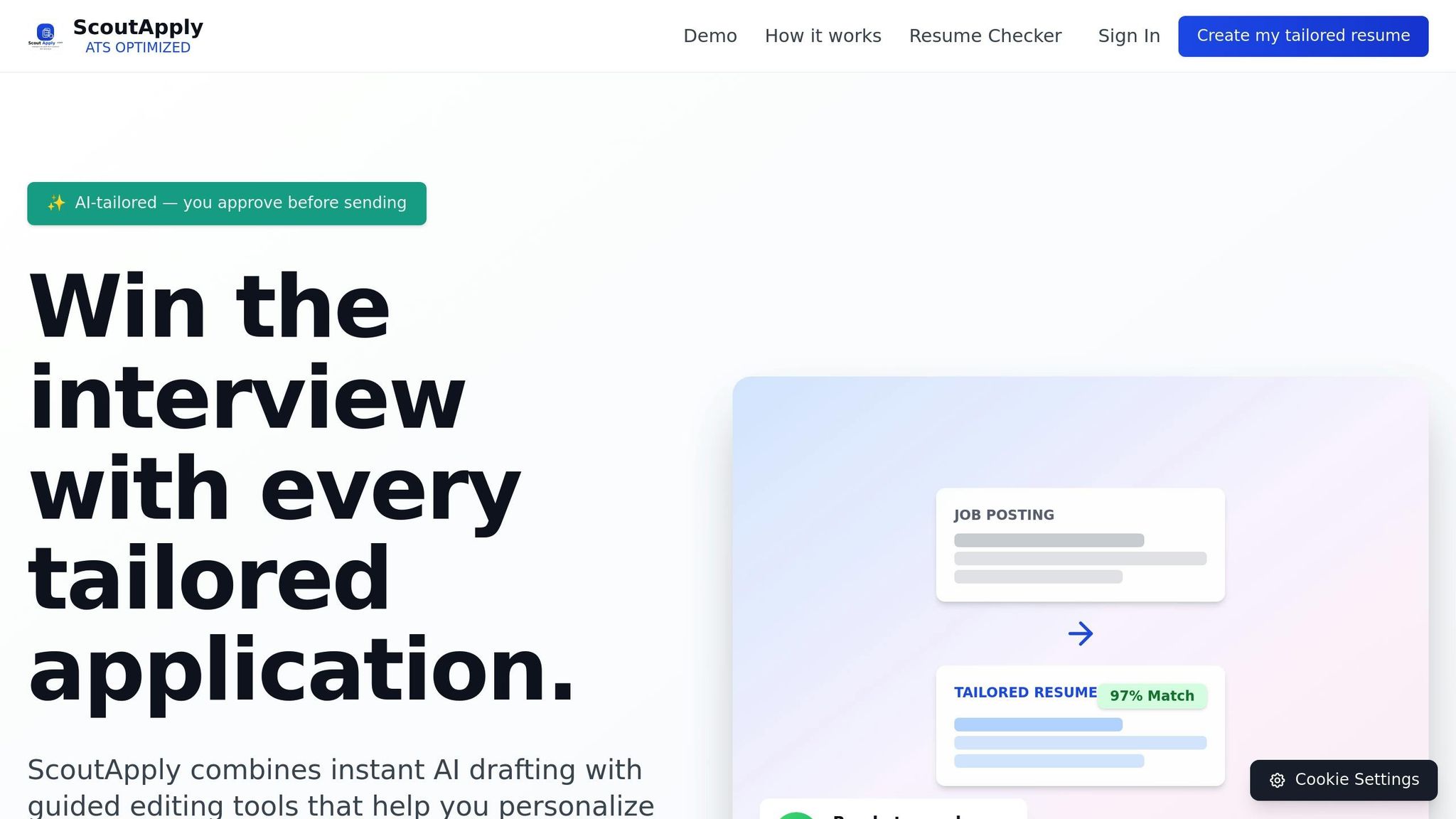
ScoutApply.com's JobSentry platform is designed to help you refine your resume with ATS-ready templates, guided editing features, and a dashboard to track your applications. The platform offers templates tailored to the U.S. job market and provides resources to align your resume with potential interview discussions, ensuring consistency throughout the hiring process.
In addition to improving your resume's content and format, AI tools make it easier to create multiple versions tailored to different roles or industries.
Creating Multiple Resume Versions
A one-size-fits-all resume rarely works in today’s competitive job market. Instead, AI tools allow you to create multiple targeted resumes, each customized for specific roles, industries, or company cultures. This ensures that every version highlights the most relevant skills and achievements for the job at hand.
AI tools also help maintain consistency across these versions while adapting the presentation of your accomplishments to resonate with different employers. For example, they can suggest alternative ways to describe your achievements based on the priorities of the target company.
To stay organized, use clear naming conventions like "Resume_DigitalMarketing_Nov2025" or "Resume_TechStartup_ProjectManager." Many AI platforms also offer built-in tools to track which version you’ve submitted to each employer and analyze response rates, helping you refine your approach for future applications.
sbb-itb-e409340
Step-by-Step Guide to AI-Driven Resume Optimization
AI-driven resume optimization is more than just stuffing keywords into your resume. With nearly 99% of Fortune 500 companies using Applicant Tracking Systems (ATS) and 73% relying on AI screening tools as of 2024, following a structured process can make a huge difference in your chances of landing an interview.
Uploading and Analyzing Your Resume
Start by logging in to ScoutApply.com's JobSentry and selecting the resume optimization feature. Upload your resume in .docx or .pdf format - these are the most ATS-friendly file types that keep your formatting intact. Once uploaded, the platform scans your resume for structure, keyword density, and overall ATS compatibility.
Next, copy and paste the full job description of your target position into the analysis field. Include every detail - required qualifications, preferred skills, and even hints about the company’s values or priorities. The AI then compares this information to your resume, identifying gaps and areas for improvement. This step refines your keyword strategy and ensures your resume aligns better with the job description.
You’ll receive a compatibility score that shows how closely your resume matches the job requirements. This score takes into account keyword usage, skills alignment, and formatting. It also highlights specific weaknesses, like missing technical skills, vague achievements, or formatting issues that could confuse ATS systems. For example, the AI might flag a lack of quantified results or missing job-specific keywords. And here’s a game-changing stat: candidates whose resumes include 80% of job-specific keywords are 2.3 times more likely to secure interviews.
Implementing AI Recommendations
The platform provides a list of actionable suggestions, ranked by the impact they’ll have on your resume. Start with the most critical keyword gaps - these are essential skills or qualifications mentioned in the job description that your resume doesn’t yet include. For technical roles, this might mean adding specific programming languages, software tools, or methodologies.
When adding these keywords, make sure they fit naturally into your experience. For example, if the AI suggests including "cross-functional collaboration", you could update a generic bullet point like "Worked with different teams" to something more specific: "Led cross-functional collaboration between engineering, marketing, and sales teams to launch products 25% ahead of schedule."
Formatting is another area where AI can help. Since 70–75% of resumes are rejected due to poor formatting, the AI might flag issues like graphics, tables, or unusual fonts that ATS systems struggle to process. Replace these with clean, text-based formatting that’s both visually appealing and machine-readable.
Revise your achievement statements based on the AI’s input. Transform vague descriptions into impactful, quantified results. For example, instead of saying "Improved sales processes", you could say, "Redesigned sales processes, increasing team efficiency by 15%." Once these changes are made, you can monitor your progress using the platform’s dashboard.
Tracking and Managing Applications
After optimizing your resume, it’s important to track how well your changes are working. The integrated dashboard makes this easy, replacing clunky spreadsheets with real-time insights.
You can save multiple versions of your resume, each tailored to a specific role or industry. Use clear naming conventions to keep everything organized. For example, "Marketing_Manager_Resume" or "Software_Engineer_Resume."
The dashboard also tracks key metrics like submission dates, company responses, interview invites, and final outcomes. This helps you see which optimizations are working and which types of jobs are generating the best responses. Users of similar platforms have reported getting three times more interviews and cutting their job search time in half.
You can even set reminders for follow-ups, interview preparation, and application deadlines. Over time, the platform’s analytics can identify patterns - like which industries are most responsive to your applications or which keywords consistently lead to interviews.
Finally, take advantage of the browser extension to streamline your application process. It can automatically save job postings and pre-fill application forms using your optimized resume data. This not only saves time but also ensures consistency across all your applications.
Advanced Resume Strategies for US Job Seekers
Once you've mastered the basics of applicant tracking systems (ATS), it's time to focus on strategies that help your resume stand out in the competitive US job market. These advanced techniques go beyond just ticking technical boxes - they aim to build a connection with hiring managers and showcase how well you align with the company's values.
Personalizing for Company Culture
In the US, aligning with a company's culture can be a game-changer. Start by researching the company's core values - check their website, LinkedIn, and employee reviews. Pay attention to recurring themes in their job postings or social media. For example, if a tech startup highlights "innovation" and "agility", mirror that in your resume. Instead of saying, "Led software development project", you could say, "Pioneered agile development to accelerate product launch by 40%."
Tailoring your resume also means using industry-specific language. For instance, a resume for a financial services role should emphasize skills like precision, risk management, and regulatory compliance. On the other hand, a tech company might be more interested in innovation, scalability, and user experience. Startups often value adaptability and the ability to handle ambiguity, while large corporations may look for expertise in process improvement and cross-functional teamwork. Adjust your wording to match the company's size and industry focus.
Once your resume reflects the company's culture, the next step is to make your accomplishments stand out by quantifying them.
Achievement Quantification in US Standards
Quantifying your achievements is one of the most effective ways to make your resume impactful. Use US-specific conventions when doing so - write results like "$125,000 in cost savings" or "$2.5M revenue increase." If you're including dates, follow the MM/DD/YYYY format.
To resonate with US hiring managers, tie your achievements to key performance indicators (KPIs) that are commonly used in the country. Examples include improving customer satisfaction scores, increasing Net Promoter Scores (NPS), or maintaining high system uptime. Provide clear details, such as "supervised a 12-person team" or "managed a 50,000 sq ft warehouse", and use familiar measurements like "overhauled a 25-mile distribution route."
Quantified achievements not only enhance your resume but also set the stage for meaningful interview discussions.
Using Interview Preparation Tools
Your resume isn't just a document - it's a roadmap for interview conversations. Expand on your quantified achievements to create STAR (Situation, Task, Action, Result) stories. For example, a bullet point like "reduced customer churn by 23% through targeted retention campaigns" can turn into a detailed discussion about your approach to customer relationship management.
Take advantage of interview preparation tools to identify gaps between your resume and typical interview questions for your target role. If these tools suggest that questions about conflict resolution might come up, you can revise your resume to include an example or achievement that highlights your experience in this area.
For technical roles - like those in engineering or data science - be sure your resume includes specific technologies, methodologies, and projects you’re ready to discuss in detail. Avoid listing skills you can’t confidently demonstrate during a coding challenge or whiteboard session.
Lastly, prepare talking points for every section of your resume. Practice explaining the context of your achievements, the challenges you faced, and the lessons you learned. This preparation will help you communicate your experience naturally and effectively during interviews.
Conclusion: Key Takeaways for Resume Optimization
To make your resume stand out, you need to balance technical precision with personalized storytelling. In today’s job market, your resume must first pass through ATS (Applicant Tracking System) filters before it reaches a recruiter’s desk. This makes ATS compliance just as critical as crafting engaging content.
Start with the basics of ATS compliance: stick to simple formatting, use standard fonts, and clearly label your headers. Avoid including graphics, tables, or unconventional layouts, as these can confuse ATS software and lead to parsing errors.
AI-powered tools are changing the game for job seekers. These tools can analyze job descriptions to identify essential skills and keywords, pinpoint gaps in your resume, and even provide real-time feedback or scoring to help you refine your content. Features like generating tailored summaries or creating industry-specific bullet points based on your experience make customizing your resume faster and more effective.
But technical optimization alone isn’t enough. Personalization is what sets you apart in a competitive job market. Tailor your resume to reflect the company’s values, use language specific to the industry, and quantify your achievements using US-standard measurements and currency formats. Think of your resume as more than a list of qualifications - it should tell a cohesive story that aligns with the job requirements and the company’s mission.
FAQs
How do I find the most important keywords to include in my resume for a specific job?
To pinpoint the key keywords for your resume, begin by thoroughly examining the job description. Focus on repeated words or phrases, particularly nouns and action verbs, as these often reflect the core skills or qualifications the employer values most.
Pay close attention to sections like "Required Qualifications", "Preferred Skills", and "Job Responsibilities." These areas typically highlight what the employer is looking for. For an added edge, consider using AI tools or keyword analyzers to compare your resume with the job description. These tools can help identify any gaps and ensure your resume aligns with the role. By weaving these keywords naturally into your resume, you'll not only improve your chances of passing applicant tracking systems (ATS) but also make a strong impression on recruiters.
What are some common resume formatting mistakes that could make it incompatible with ATS?
When it comes to making your resume ATS-friendly, certain formatting choices can cause big problems. Here are some common mistakes to avoid:
- Using intricate templates with tables, graphics, or multiple columns. ATS software often struggles to process these elements correctly.
- Placing contact details or section titles in headers or footers. Many ATS programs fail to recognize information in these areas, which could mean crucial details are missed.
- Relying on special characters or symbols. These can interfere with keyword detection, potentially lowering your resume's ranking.
- Submitting the wrong file type. Formats like images or non-text-readable PDFs can’t be processed by ATS. Stick to Word documents (.docx) or text-readable PDFs designed for ATS compatibility.
Keeping your resume simple, clear, and optimized with relevant keywords ensures it’s more likely to be accurately read and ranked by ATS software.
How can AI tools help personalize my resume for specific job applications?
AI tools can help fine-tune your resume by analyzing job descriptions to pinpoint the key skills and keywords employers are looking for. They can also recommend ways to adjust or improve your bullet points, making your qualifications and achievements shine.
On top of that, these tools can assist in adding measurable results to your resume, helping you clearly demonstrate the impact of your work. By customizing your resume for each job, you increase your chances of getting through Applicant Tracking Systems (ATS) and grabbing a recruiter’s attention.