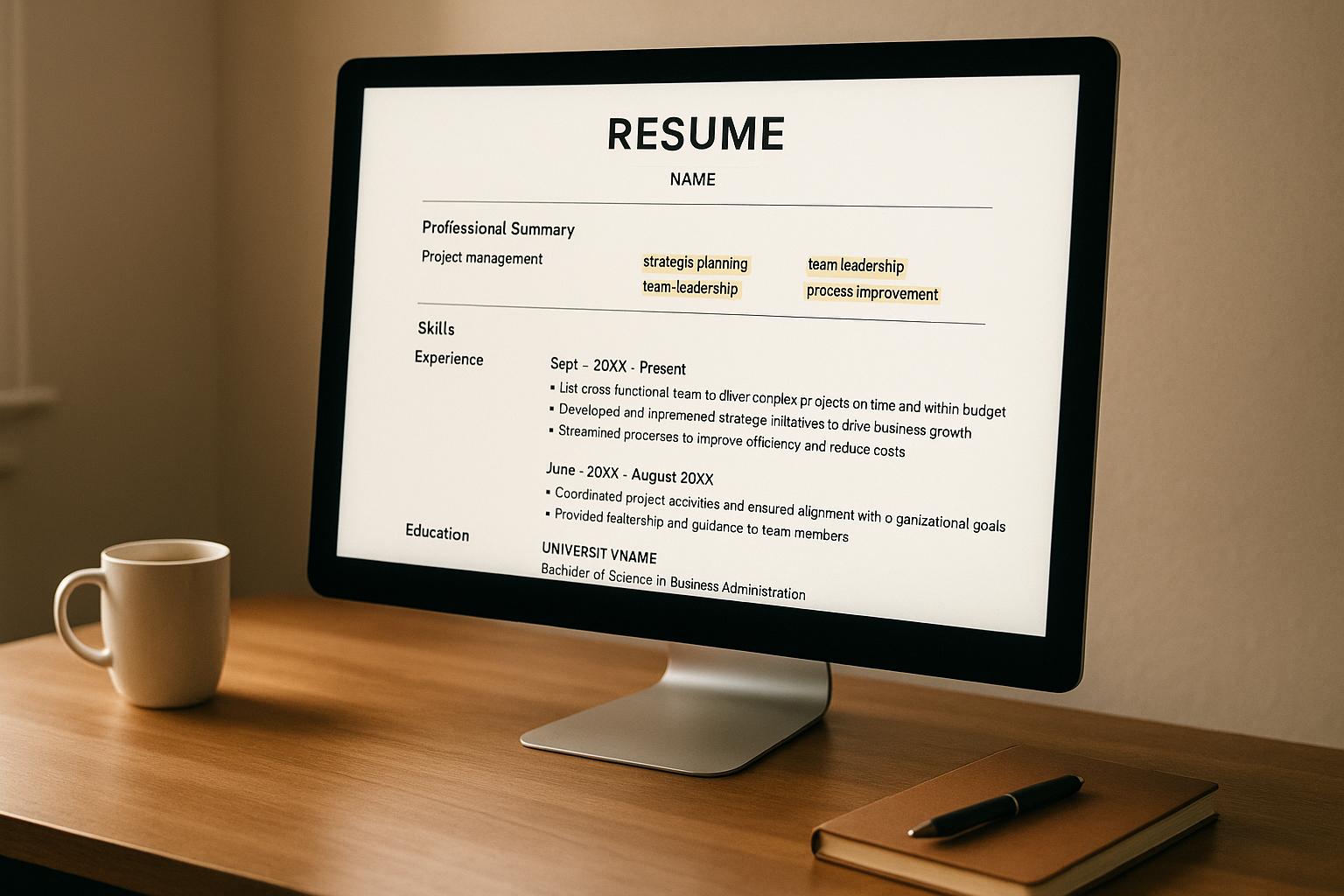
Resume Keywords: Complete Guide for Job Seekers
Want to land more interviews? The secret lies in using the right resume keywords. With 90% of companies relying on Applicant Tracking Systems (ATS) to screen applications, tailoring your resume to include job-specific terms is essential. Here’s what you need to know:
- Why it matters: 75% of resumes are rejected by ATS due to missing keywords.
- What they are: Keywords include skills, certifications, tools, and industry-specific terms from job descriptions.
- How to use them: Focus on areas like your professional summary, skills section, and work experience.
Pro tip: Use exact phrases from job postings and avoid keyword stuffing. Tools like JobSentry can help optimize your resume for ATS while keeping it recruiter-friendly.
Keep reading to learn how to identify, integrate, and maximize resume keywords for your job search success.
How to Find the Best ATS Resume Keywords
How to Find the Right Keywords
Understanding the importance of resume keywords is just the beginning. To truly make your application shine, you need to pinpoint the exact terms that resonate with employers. This involves carefully analyzing job postings and identifying the specific language that can set your resume apart. Below, we’ll explore how to extract these keywords and incorporate them effectively.
Finding Keywords in Job Descriptions
Job descriptions are your go-to resource for discovering the exact keywords employers prioritize. But instead of skimming through them, take a methodical approach to uncover the most valuable terms.
Start by thoroughly reviewing the sections on qualifications, skills, and responsibilities. These areas often contain the keywords that applicant tracking systems (ATS) are programmed to detect. For example, if "project management" is mentioned in the job title, requirements, and responsibilities, it’s a clear indicator that this term is critical for your resume.
Whenever possible, use the exact wording from the job posting. As Robert Henderson, CPRW and Resume Expert at Jobscan, advises:
"Match the exact phrasing. The ATS doesn't always recognize synonyms, so mirror the wording used in the posting".
Pay close attention to unique or company-specific terms. ATS systems may be designed to pick up specific wording, so mirroring these terms exactly can make a big difference.
Also, take note of job titles. Companies often use variations for similar roles, such as "Customer Success Specialist" instead of "Customer Service Representative." Incorporating their specific terminology into your resume can help align it with their expectations.
Lastly, check the company description and culture sections for values-based keywords like "collaboration", "data-driven", or "innovation." Including these terms can help demonstrate both your technical and cultural alignment.
Researching Industry Keywords
While job descriptions give you a snapshot of what a particular employer values, broader industry research helps you identify the standard terms and trends that apply across multiple companies. This ensures your resume stays relevant, even if certain keywords aren’t explicitly mentioned in a specific posting.
Start by reviewing several job postings for similar roles across different organizations. Compile a list of recurring terms - these are likely the industry standards that most employers are looking for.
Dive into industry publications, blogs, and professional association websites. These sources often highlight trending terminology, technical jargon, and emerging skills that can give your resume a competitive edge.
Explore professional networking profiles, especially on platforms like LinkedIn. Look at how successful individuals in your target roles describe their skills and experience, and take note of the language they use.
Stay updated on new technologies, certifications, and methodologies in your field. Industries evolve quickly, and keeping your resume aligned with current developments ensures it reflects the most relevant terminology.
Finally, check out industry-specific job boards and career sites. These platforms often feature the latest postings, giving you insight into what employers are prioritizing right now.
Using Company-Specific Language
Every company has its own way of describing roles, responsibilities, and values. Adapting your resume to reflect this unique language can make a strong impression on both ATS systems and recruiters, showing that you’ve done your homework and align with their culture.
Start by reviewing the company’s website and LinkedIn profiles. Pay particular attention to sections like "About Us", "Culture", and "Values." These areas often highlight the terminology that reflects the company’s mission and work environment. Using this language in your resume signals that you understand and align with their vision.
Dig deeper by researching employee profiles at your target company. These can provide insight into the internal language and terms that employees use to describe their roles.
Be mindful of job titles, as they can vary widely between companies. If your previous title doesn’t match the one used in the job posting, consider including both versions to ensure compatibility with the ATS.
Lastly, review the company’s product or service descriptions. This can help you identify technical terms or industry-specific language that’s central to their operations. For nonprofits, startups, or mission-driven organizations, look for language that reflects their unique goals and values. Adopting their terminology not only improves ATS recognition but also shows recruiters that you’ve taken the time to understand their organization.
How to Add Keywords to Your Resume
Once you've pinpointed the right keywords, the next step is weaving them naturally into your resume. The goal? Impress both the ATS (Applicant Tracking System) and the human recruiter. With 75% of recruiters relying on ATS software before even glancing at a resume, strategic keyword placement is essential to make it past this initial hurdle.
Where to Place Keywords
Some sections of your resume are goldmines for keyword integration. Here’s where you should focus:
- Professional Summary: This section, right at the top, is often the first thing both ATS and recruiters scan. Use this space to include the job title you’re targeting and highlight 2–3 key skills that align closely with the role. Think of it as your elevator pitch, tailored for ATS and humans alike.
- Skills Section: This is where you can directly list hard and soft skills pulled straight from the job description. Be specific and avoid generic terms. Instead of just listing them here, sprinkle these keywords naturally throughout your resume for better impact.
- Work Experience: This is your chance to pair keywords with action verbs and measurable results. For instance, instead of saying, "responsible for project management", you could write, "Led cross-functional project management initiatives, achieving a 15% reduction in costs." This approach not only highlights your skills but also demonstrates your contributions.
- Job Titles: If your previous job title is similar to the one you’re applying for but slightly different in wording, tweak it to match the job posting. Just make sure it remains truthful to your actual responsibilities.
While it’s important to include keywords in these areas, readability should never take a backseat. Keyword stuffing won’t do you any favors, as explained below.
Avoiding Keyword Overuse
Overloading your resume with keywords can backfire, leading to poor readability and even ATS rejection. Instead, aim for a balanced approach - use each core keyword 2–3 times throughout your resume. For example, you could include a keyword in your professional summary, once in your work experience, and again in your skills section. This keeps the keyword density effective without making your resume feel forced or robotic.
The key is to create a resume that’s optimized for ATS while remaining engaging and clear for the human eye.
Using Exact Match Phrases
When placing keywords, it’s important to use the exact wording from the job description. Many ATS systems are literal, meaning they may not recognize synonyms or alternative phrases. For example, if the job posting mentions "Adobe Creative Suite", use that exact term instead of "Adobe Creative Cloud" to ensure compatibility with the system.
That said, don’t rely solely on exact matches. Some advanced ATS systems can recognize variations, and recruiters appreciate resumes that demonstrate strong communication skills through varied language. A mix of exact matches and semantic variations ensures your resume appeals to both ATS and human readers.
For technical terms or acronyms, include both the full term and its abbreviation. For instance, write "Search Engine Optimization (SEO)" instead of just "SEO". This approach ensures you cover all bases and improve your chances of being noticed.
sbb-itb-e409340
Top Resume Keywords by Industry and Role
When it comes to crafting a standout resume, industry-specific keywords can make all the difference. Each field has its own language, and aligning your resume with the terminology and skills valued in your target industry can be the key to landing an interview. Employers and Applicant Tracking Systems (ATS) are looking for tailored resumes, so using the right keywords ensures your application gets noticed.
Here’s a closer look at essential keywords across several industries, designed to align your resume with employer expectations and ATS filters.
IT and Technology Keywords
In tech roles, precise language is everything. Employers often look for specific technical skills that are non-negotiable. Make sure to include programming languages like Python, Java, JavaScript, C#, and C++, as well as newer ones like TypeScript, Swift, and Kotlin.
Highlight your experience with frameworks such as React, Angular, Vue.js, Node.js for front-end development, and Django, Flask, Spring Boot, or .NET for back-end work. Don’t forget to mention expertise in cloud platforms like AWS, Microsoft Azure, or Google Cloud Platform, along with familiar DevOps tools such as Docker, Kubernetes, Jenkins, and CI/CD pipelines. If your role involves infrastructure, tools like Terraform and Ansible can set you apart.
For data-related positions, database skills are crucial. SQL is a must-have, but don’t overlook NoSQL databases like MongoDB and Redis. Include terms like ETL processes, Apache Spark, Hadoop, and machine learning algorithms if they apply. For analytics roles, keywords like Tableau and Power BI can further strengthen your resume.
If your expertise is in system administration, focus on terms like Windows Server, Linux, Unix, Active Directory, VMware, and Hyper-V. Networking skills, such as firewall configuration, network security, and router management, are indispensable for infrastructure and cybersecurity roles.
While IT roles emphasize technical expertise, healthcare resumes demand a completely different focus.
Healthcare and Medical Keywords
Healthcare resumes need to strike a balance between clinical expertise, regulatory knowledge, and interpersonal skills. Start with clinical certifications, ensuring they match the exact job requirements. Use both the full name and abbreviation (e.g., Registered Nurse (RN)) for ATS compatibility.
Accurate medical terminology is vital. Common keywords include patient care, clinical assessment, medication administration, and treatment planning. For specialized roles, add terms like cardiac care, pediatric nursing, or geriatric assessment.
As healthcare becomes more tech-driven, healthcare technology keywords are increasingly important. Highlight your experience with Electronic Health Records (EHR), Electronic Medical Records (EMR), or specific systems like Epic, Cerner, or Meditech. Emerging terms like telemedicine and remote patient monitoring can also give your resume an edge.
Don’t forget regulatory compliance keywords. Terms like HIPAA compliance, infection control protocols, Joint Commission standards, and quality assurance demonstrate your understanding of industry regulations. For administrative roles, include healthcare billing, medical coding, and insurance verification.
Finally, showcase your interpersonal skills with patient interaction keywords. Words like patient advocacy, care coordination, family education, and interdisciplinary collaboration highlight your ability to communicate effectively and prioritize patient-centered care.
Just as healthcare and IT have unique requirements, finance and operations roles call for their own specialized language.
Finance and Operations Keywords
Finance and operations resumes should emphasize both technical proficiency and strategic thinking. Start with key finance terms like financial modeling, variance analysis, budget forecasting, and cost-benefit analysis. For leadership roles, include strategic planning, capital allocation, and risk assessment to highlight your ability to make high-level decisions.
Proficiency in software tools is essential. For entry-level roles, advanced Excel skills - pivot tables, VLOOKUP, and macros - are often required. Analyst roles may benefit from keywords like SQL, Python, R, and statistical analysis. Mentioning financial software like SAP, Oracle Financials, QuickBooks, or Bloomberg Terminal can further demonstrate your technical skills.
Understanding regulatory standards is critical in finance. Include terms like GAAP (Generally Accepted Accounting Principles), SOX compliance (Sarbanes-Oxley), internal controls, and audit preparation. For investment management positions, keywords like SEC regulations, fiduciary responsibility, and portfolio management are valuable.
In operations, focus on efficiency and process improvement. Keywords like lean manufacturing, Six Sigma, process optimization, and supply chain management showcase your expertise. Certifications like PMP (Project Management Professional) or Agile methodology can highlight your ability to lead projects effectively.
Finally, include performance metrics keywords to show your results-driven approach. Terms like KPI development, performance dashboards, ROI analysis, and operational efficiency are especially impactful. For leadership roles, highlight skills like change management, team development, and cross-functional collaboration.
ScoutApply.com: AI-Powered Solutions for Resume Optimization
Crafting a resume that seamlessly integrates the right keywords for multiple job applications can be tough. That’s where JobSentry by ScoutApply.com steps in. This AI-driven tool simplifies the process, helping job seekers create resumes that not only pass Applicant Tracking Systems (ATS) but also grab the attention of hiring managers.
With features like AI-assisted resume and cover letter creation, guided editing tools, and ATS-friendly templates, JobSentry ensures your application is polished for both algorithms and human eyes. The platform doesn't stop there - it also offers an application tracking dashboard, interview preparation tools, and AI-powered job discovery. It’s an all-in-one solution for anyone navigating today’s competitive job market, building on the keyword strategies we’ve already discussed.
Features of JobSentry
JobSentry provides a suite of tools designed to streamline your job search and optimize your resume:
- AI-Powered Drafting Tools: Generate resumes and cover letters tailored to specific roles, moving beyond generic templates.
- Guided Editing: Fine-tune your resume to meet ATS standards while keeping it clear and engaging for recruiters.
- ATS-Optimized Templates: Access professional templates crafted to ensure smooth parsing by ATS software.
- Application Tracking Dashboard: Keep tabs on your job applications and stay organized throughout the process.
- Additional Features: Prepare for interviews and leverage AI job discovery to connect with opportunities that match your skills.
This holistic approach emphasizes the importance of precise keyword usage, ensuring your resume meets modern hiring standards.
How JobSentry Enhances ATS Compliance
JobSentry uses guided editing and analytics to perfect your resume's formatting and keyword integration. The result? A resume that strikes the right balance between ATS compatibility and recruiter appeal.
Pricing Plans for ScoutApply Users
ScoutApply offers flexible pricing to suit different needs, starting with a free Trial plan. The Plus and Pro plans, priced at $7.99 and $12.99 per month respectively, provide additional features for more advanced users.
| Plan | Monthly Price | Resumes | Applications | Cover Letters | Key Features |
|---|---|---|---|---|---|
| Trial | $0.00 | 1 | 1 | 1 | Basic templates, AI job discovery, interview prep |
| Plus | $7.99 | 5 | 5 | 5 | Premium templates, email support, priority support |
| Pro | $12.99 | 20 | 20 | 10 | Advanced analytics, monthly AI job discovery |
Every plan includes access to JobSentry's core keyword optimization tools, ensuring that users can create ATS-compliant resumes that leave a lasting impression. Whether you're just starting or looking to elevate your job search, there’s a plan to fit your needs.
Conclusion
Resume keywords are now a critical piece of the modern job search puzzle. Without them, even the most well-crafted resumes risk being filtered out by ATS systems before a recruiter ever sees them. By applying the strategies discussed - like analyzing job descriptions and strategically weaving keywords into your resume - you can significantly improve your chances of securing interviews.
It’s all about striking the perfect balance. Your resume needs enough relevant keywords to pass ATS screening but not so many that it feels overloaded or unnatural. Prioritize terms that reflect your actual experience, including industry-specific jargon, technical skills, and action-oriented verbs.
Staying current is essential too. The job market shifts quickly, and keyword trends evolve just as fast. What worked yesterday might not work today. Tools like JobSentry can be incredibly helpful, keeping you updated on the latest keyword trends while ensuring your resume maintains a personal, human touch that stands out to hiring managers. This highlights the importance of keeping your resume dynamic and aligned with the ever-changing hiring landscape.
FAQs
How do I find the right keywords to include in my resume for a job application?
To identify the best keywords for your resume, start by carefully analyzing the job description. Pay close attention to repeated terms like specific skills, qualifications, certifications, or tools listed in the requirements. These are often prioritized by both hiring managers and Applicant Tracking Systems (ATS).
Additionally, focus on using action verbs and industry-specific language that aligns with the job. For instance, if the posting highlights terms like "project management" or "data analysis", be sure to weave these phrases naturally into your resume. By mirroring the language in the job description, you’ll improve your chances of catching the attention of both ATS software and potential employers.
What mistakes should I avoid when adding keywords to my resume to ensure it passes ATS screening?
To ensure your resume makes it past ATS (Applicant Tracking System) screening, steer clear of these common pitfalls:
- Keyword stuffing: Overloading your resume with keywords can make it feel forced and difficult to read. Aim for natural integration instead.
- Using vague or unrelated terms: Stick to keywords that directly match the job description and reflect your actual skills.
- Skipping customization: Sending the same resume for every job won't cut it. Tailor your resume to align with the specific role you're applying for.
- Inconsistent formatting: Disorganized formatting can trip up ATS systems and make your resume harder to process.
Also, avoid submitting formats like images or certain types of PDFs that ATS tools may struggle to read. Stick with straightforward formats, such as Word documents (.docx) or ATS-friendly PDFs. Prioritize clarity and relevance to ensure your resume not only passes the ATS but also grabs the attention of hiring managers.
Why is it important to use industry and company-specific keywords in my resume?
Including industry-specific and company-specific keywords in your resume is essential because many recruiters and hiring managers use applicant tracking systems (ATS) to screen candidates. These systems are designed to scan resumes for terms that align with the job description. When your resume features the right keywords, it has a better chance of ranking higher in searches and catching the recruiter’s attention.
Customizing your resume to reflect the language and terminology of the specific role and company shows that you understand the job’s requirements and the industry’s nuances. This approach not only helps you navigate the ATS but also highlights the effort you’ve put into tailoring your application for the position.